Send a project component to the Deleted items folder
If you aren't using a component anymore, you can move it to a folder for archiving, or you can send it to the Deleted items folder, where it stays until you delete it permanently.
 The Update and Delete component permissions are no longer tied together.
- If you want to move a component between project folders, you must have the Update permission for the component. The Update permission no longer lets you also delete the component by default. You must explicitly have the Delete permission to send the component to the Deleted Items folder.
- If you have permission to delete a component, you can no longer also move the component between folders by default. You must explicitly have the Update permission to move a component.

 You can't delete a component if it's:
- Locked (by another user, by you, or by the system)
- Part of an active assignment
- Part of an active review
- Used in a Projects folder
- Used in a publishing profile
If you try to delete a component that's included in a publishing profile, you see the following message:
Cannot delete components because one or more are used in a publishing profile. Clear all publishing profile references to these components or remove them from your selection and try again.
You also see this warning if you try to delete a folder that contains a component included in a publishing profile.You see this warning, and you can't delete the component(s).
Do one of the following:
- Update a publishing profile and remove this component
- Delete a publishing profile that includes this component
- Referenced by another component
If the component has a relationship with other components, you see the following error when you try to delete it:
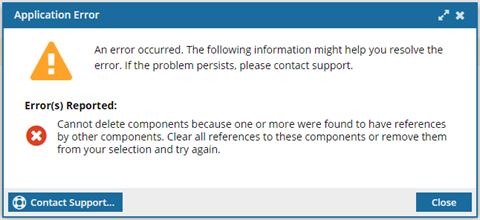
To find relationships so that you can remove any links and delete a component, follow the steps in See where a component is used.
Force Deletion. If an administrator enables a feature that allows components to be deleted and relationship links broken, and you are an administrator, you can force Inspire to delete the component. For more details, Administrators can read: Allow forced deletions.
- You cannot force the deletion of a topic if it is referenced by a locked component.
- For more information, see the steps below or read Delete Components.
 You can also send a component to the Deleted items folder from the Components browser. Follow the steps in: Send a component to the Deleted items folder.
To send a project component to the Deleted items folder:
-
Click
 Projects.
-
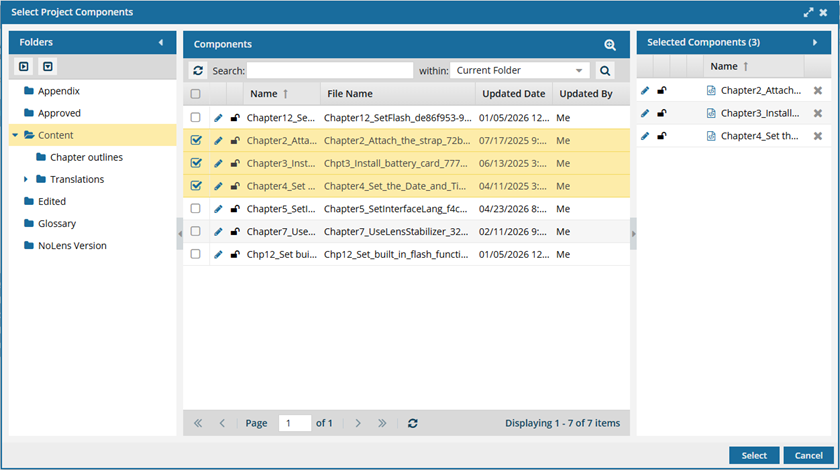
In the Content pane, select the checkbox next to the project components you want to remove.
To see the complete name of the components and use advanced search to search through all folders within a project, click
 the Select Project Components option.
- To see more text in the Components pane, collapse the Folders panel by clicking
 the arrow that's pointing left.
- To quickly expand or collapse the folders, use the
 expand all and
  collapse all buttons.
- To find a component by keyword, in Search, enter words or phrases used in the component's name. In Within, select where in the project you want to search (Current Folder, Current and Subfolders, All Folders). Click Search
 .
. - To find a component by creating a query, click
 Advanced Search.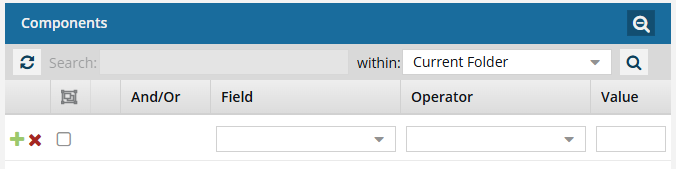
- Fields correspond to the columns in the grid. In the Field list, select the column you want to search in, such as Component State.
- After you select a Field, you must describe the relationship it has with the Value. In the Operator list, to include or exclude some or all of the values that you want to use, select an operator, such as
<>(not equal to). - The options in the Value list change depending on what you selected in Field. In the Value, select or enter the word, phrase, or number you are searching for in relation to the Field. For example, Component State (Field)
<>(Operator) Invalid (Value). - In Within, select where in the project you want to search (Current Folder, Current and Subfolders, All Folders).
- Optionally, to enter another clause to your query, click
 Add. Select whether you want to narrow your search by requiring that all statements must be true (And), or expand your search by requiring that any of the statements can be true (Or).
 - Click Search .
- To select multiple components to manage, select the checkbox for each component.
 Result: The components are listed on the Selected Components panel.
 - To close the Select Project Components screen, click Select
- To see more text in the Components pane, collapse the Folders panel by clicking
-
In the Selected Components pane, click
 the More menu and then click
  Delete.

-
On the confirmation screen, click Yes.
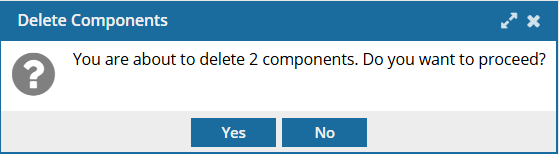 If an administrator enables a feature that allows components to be deleted and relationship links broken, and you are an administrator:
- You are asked if you want to force the deletion of the component and break links
If you select Yes: - If the component is referenced by a locked component, you see an error. In this case, the component is not deleted. To force the deletion, you must unlock the component that references it first, and then try again.
- The selected components are moved to the Deleted Items folder.
- Link relationships are broken.
- Components that reference the deleted topic are marked as invalid.
- If you are not also deleting the component that referenced the deleted one, you can use Rebuild All Relationships to help resolve linking errors.
If you select No:
- You must manually remove links from other components that reference the one you want to delete
Results:- The components are cleared from the Selected Components pane.
- The components are sent to the Deleted Items folder. If you need to use the component again, go to the Deleted items folder where it's stored until you permanently delete it. Right-click the component and choose Restore.
- You no longer see the components listed in the Content pane.
- If you can't delete a component, read the message that appears telling you the reasons why. Correct the issue before trying to delete the component again.