Manually repair an invalid project component relationship
You can repair a relationship by manually selecting a new component or element when a reference to another component is broken or invalid.
 Permission requirements
- A content owner or administrator can set permissions to deny access to components or folders. If your permissions to content have been blocked, and you are not an administrator, you cannot use the Advanced options in a project's Content pane.
The
 AutoRepair and Rebuild All Relationships options may not be available. To use them, you must have one of the following permissions:
- Administrator
- Content browser module permissions with the can_rebuild_relationships property.
Administrators can grant access to non-admin users or roles by following the steps in Allow a non-admin user to rebuild relationships.

 Tips and Tricks
- You can also do this action from the Components browser. Follow the steps in: Manually repair an invalid component relationship.
- You can only create relationships to elements with ID values. For more information, read Repair component relationships.
- If you aren't sure how to manually fix a relationship issue, you can use an auto-repair tool first to see if that fixes the issue. If you have permissions, follow the steps in any of the following:
- If you aren't sure what to select using the Manage Relationships screen, you can open the component in the Oxygen editor and use the Validation pane to learn more about the error and fix it in the editor. Follow the steps in Check for errors in the Validation pane.
- Inspire now supports content references to ditabase topics. A ditabase topic is a composite topic. Before maps, ditabase was used to collect multiple topics and structure them within a single topic file.
- If you use a conref to a ditabase topic, Inspire no longer identifies it as an invalid relationship.
When you repair a self-referencing link, the following syntax is used:
- If a cross-reference is pointing to content in a separate file, Inspire includes the file name:
<filename>#<rootid>/<elementid> - If a cross-reference is pointing to content that exists in the same file, DITA assumes it's the same, so Inspire drops the file name:
#<rootid>/<elementid>
- If a cross-reference is pointing to content in a separate file, Inspire includes the file name:
To manually repair an invalid project component relationship:
-
Click
 Projects.
-
On the project tab, in the Content pane, to open the Content folder, click
 the Expand All arrow.
-
In the Content pane, select the checkbox for the component you want to view relationships for.
 Components with an invalid relationship display an Invalid icon
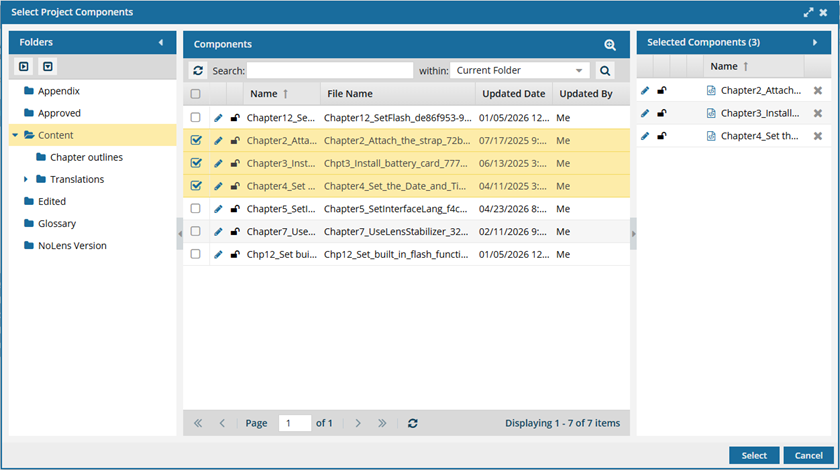
  . To see the complete name of the components and use advanced search to search through all folders within a project, click
  the Select Project Components option.
- To see more text in the Components pane, collapse the Folders panel by clicking
 the arrow that's pointing left.
- To quickly expand or collapse the folders, use the expand all and
 collapse all buttons.
- To find a component by keyword, in Search, enter words or phrases used in the component's name. In Within, select where in the project you want to search (Current Folder, Current and Subfolders, All Folders). Click Search
 .
. - To find a component by creating a query, click
 Advanced Search.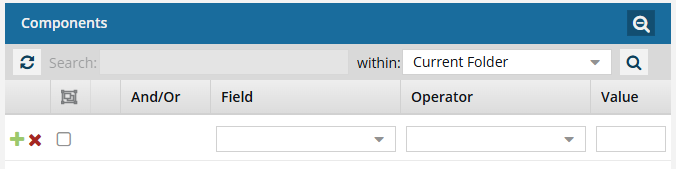
- Fields correspond to the columns in the grid. In the Field list, select the column you want to search in, such as Component State.
- After you select a Field, you must describe the relationship it has with the Value. In the Operator list, to include or exclude some or all of the values that you want to use, select an operator, such as
<>(not equal to). - The options in the Value list change depending on what you selected in Field. In the Value, select or enter the word, phrase, or number you are searching for in relation to the Field. For example, Component State (Field)
<>(Operator) Invalid (Value). - In Within, select where in the project you want to search (Current Folder, Current and Subfolders, All Folders).
- Optionally, to enter another clause to your query, click
 Add. Select whether you want to narrow your search by requiring that all statements must be true (And), or expand your search by requiring that any of the statements can be true (Or).
 - Click Search .
- To select multiple components to manage, select the checkbox for each component.
 Result: The components are listed on the Selected Components panel.
 - To close the Select Project Components screen, click Select
- To see more text in the Components pane, collapse the Folders panel by clicking
-
Right-click the component's row, select Advanced, and then select Relationships...
You can also click
 the Options menu, select Advanced, and then select Relationships...
 -
In the component's row, right-click and select Browse.
You can also click the Options menu and select Browse.
-
In the Target Element pane, select the element you want to use, and then click Select.
If you aren't sure what to select or what you want isn't listed, you can open the component in the Oxygen editor and use the Validation pane to learn more about the error and fix it in the editor. Results:
- On the Manage Relationships screen, the relationship is now listed as Valid.
- The target attribute value for the components is updated to the repaired target component file name.
- The component is saved.
-
On the Manage Relationships screen, click Close.
 When you complete a task that triggers a notification, such as repairing relationships, the Slack and email message bodies contain:
- The title and file name of the component that was repaired.
- Ten or fewer Issues, Errors, and Warnings.
- A link at the bottom of the message [See Full Version].
- You can click the [See Full Version] link to expand a section under the link with the full details.
- For more information, review the Sample Inspire notification.