Find elements using advanced search
You can build queries to find an element and see a list of all its values. This is useful if you want to check that the correct values are being used for an element.
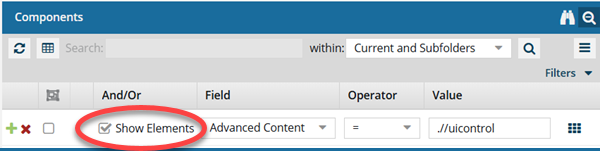
- What you can find. You can use XPath expressions to search. An XPath expression is analogous to an SQL query used to select records from a database. With XPath, you are selecting strings from an XML tree of nodes.
- Elements.
- Attributes.
- Folder Names. Follow the steps in Find a folder name using advanced search.
- Paths to a component. Follow the steps in Find a path using advanced search.
- Comments matching a set of conditions.
- Profiling attribute values not defined as valid values.
- The @outputclass attribute used to define specific styling in the output. (For example, if you're searching for all the uses of trademarks, in Value, you would use: //tm)
- Where you can find it. You can search the current topic or a set of topics for elements.

 Tips and tricks
- If the content you need to run an advanced query on is split up across different folders with different sets of permissions, and you don't want to search all folders, you can select the individual components to perform an advanced search on. Follow the steps in Use advanced search on components instead of folders.
- To create a query that finds topics being followed, use the steps in Search for topics being followed.
- Using parentheses. Inspire recognizes the parentheses character ( ) as indicating a grouping of search items. If you want to search for a text value that actually contains a parenthesis character ( ), you must tell Inspire to interpret it literally. To do that, use a slash \ before any parenthesis character ( ). For example, if you want to search for the following value: Chapter1_Intro(with_endnotes), in the Search for box you would enter Chapter1_Intro\(with_endnotes\).
 If you use an XPath statement, it must be the last criterion. If it is not last, you will see errors.
To find elements:
-
Click
 Components.
-
In the Folders pane, select the specific folder that you want to search.
 If you want to search multiple folders, select the parent folder that contains them.
 -
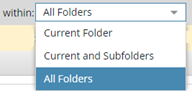
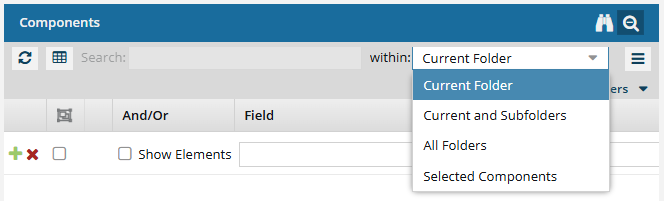
On the Components pane, in within, choose one of the following folder options.
- Current Folder
- Current and Subfolders
- All Folders
- Selected Components
-
On the Components tab, in the Components pane, click the advanced search magnifying glass
 .
.
-
Complete the following sub-steps using the query builder to add or verify search parameters.
-
In the Value field, enter the element you're searching for.
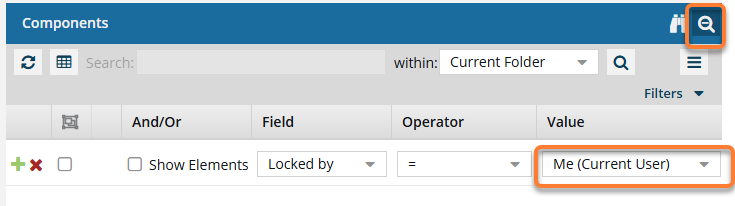
To make advanced search queries reusable and easier to share, in Value, you can select the option called Me(Current User). This option displays results for the user currently running the query, not the user who created it.
- The Me(Current User) option is available only for Advanced queries where Value requires a user.
- For example, if in Field, you select Locked by.
-
Optionally, you can click Add
 to add another search parameter. To group search parameters, select the checkboxes for two or more consecutive parameters and click Group selected clauses.
If you use multiple criteria:
to add another search parameter. To group search parameters, select the checkboxes for two or more consecutive parameters and click Group selected clauses.
If you use multiple criteria: - You can only have one field with the Advanced Content option selected.
- The Advanced Content containing the XPath statement must be the last row in the list of search parameters.
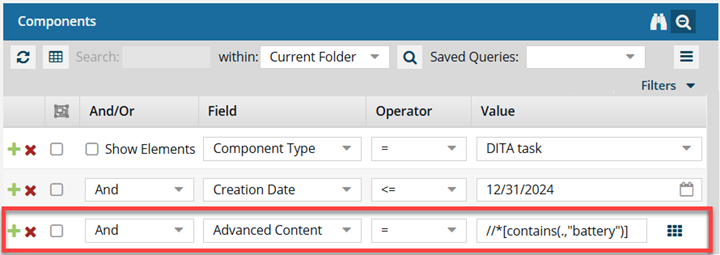
If the XPath statement is not last, you will see an Application error telling you that you used incorrect syntax.
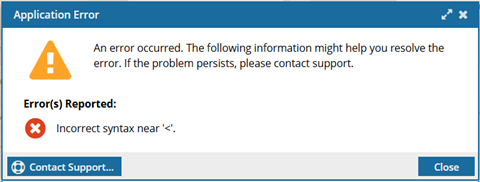
To resolve the error, move the Field with Advanced Content to the last row in the list and re-run the query.
-
In the Value field, enter the element you're searching for.
-
Click Search
 .
You can see the results in the Elements pane.
.
You can see the results in the Elements pane.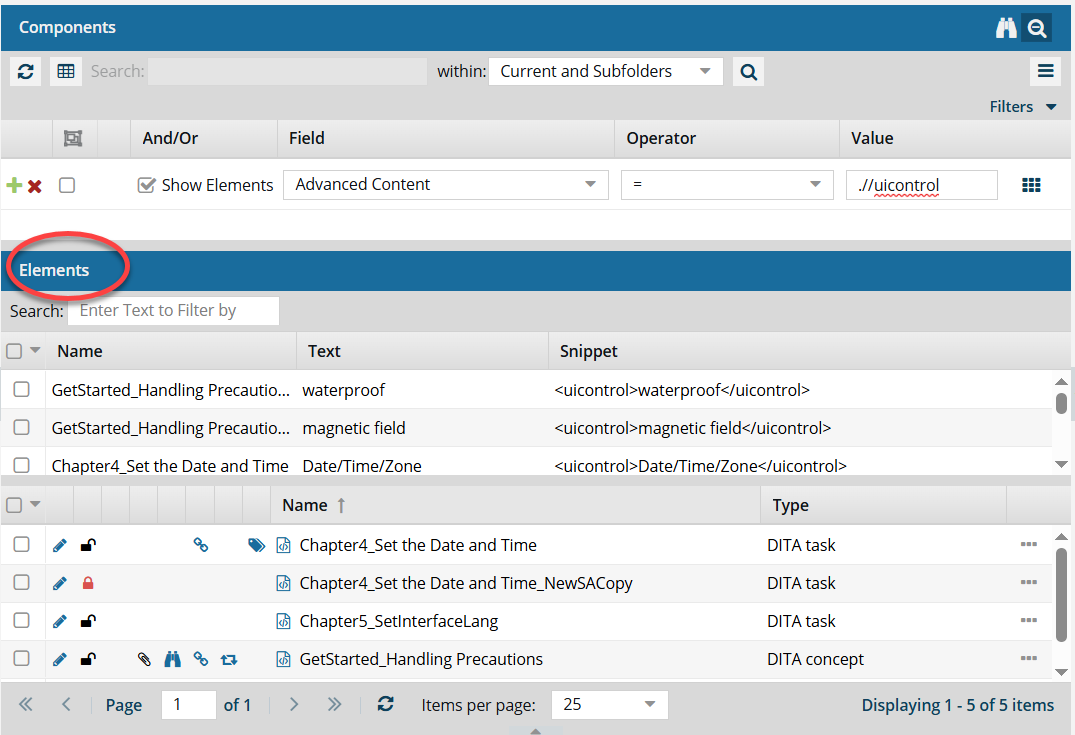
-
To save the list of components that match the search as a CSV file, click Save as CSV
 .
.